
Pin Up Andar Bahar Strategy: What Actually Works (And What Doesn't)

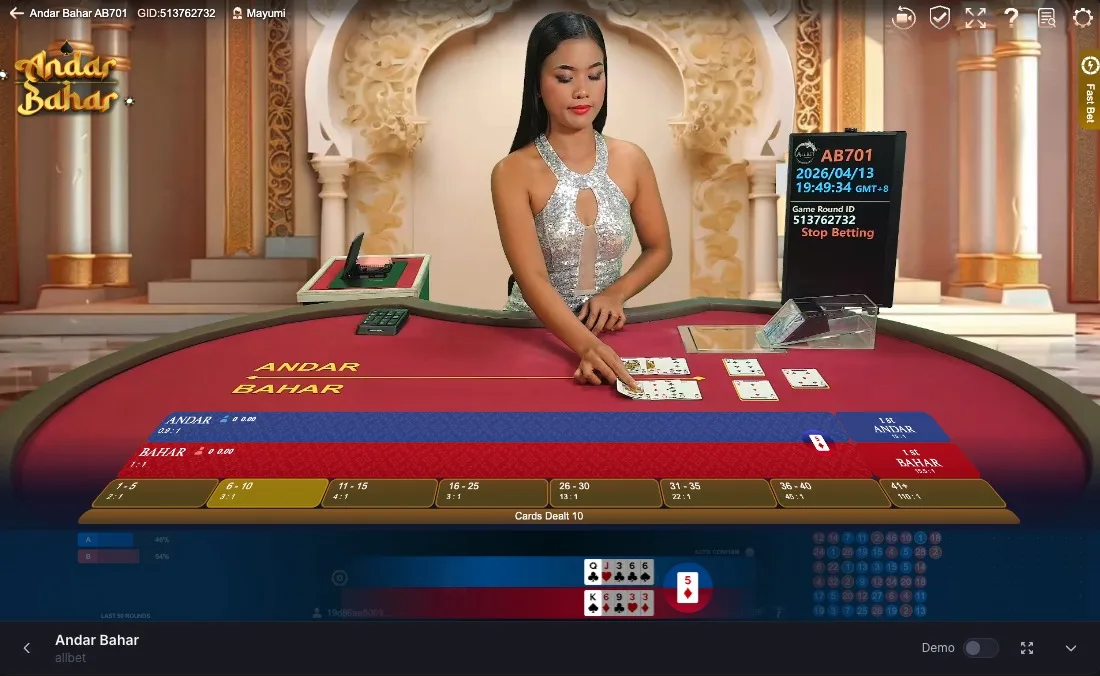
There is no strategy that changes Andar Bahar's 2.15% house edge. I have been reviewing card game rooms for 5 years and I can tell you with complete confidence: nothing you do at the table moves the math. Bet sizing does not move it. Which side you pick does not move it. "Hot dealer" observation does not move it. Martingale does not move it. The only thing you control is bankroll management and which studio you play at. This page explains why, and what to actually do instead.
The One True Fact About Andar Bahar
It's a Pure-Chance Card Game
Andar Bahar has zero decision points that affect the outcome once you place your bet. Unlike blackjack where you hit, stand, double or split based on the dealer's up card, Andar Bahar has exactly one action: pick a side. After that, the dealer deals cards and the math plays out. You cannot do anything else. The 2.15% house edge is fixed. No betting pattern, no pattern recognition, no psychological edge changes it. This is the complete opposite of poker — I grind video poker specifically because at 99.54% RTP on 9/6 Jacks-or-Better, the skill-based decision making matters. Andar Bahar has no such skill dimension.
Why Card Counting Fails Here
Single-Deck Shoe + Constant Cut Card
Card counting works in blackjack because the dealer plays deep into a multi-deck shoe, and by tracking the remaining composition you can make slightly better decisions late in the shoe. Andar Bahar uses a single-deck shoe with a shallow cut card — on Ezugi the cut sits at roughly 40% shoe depth, on Evolution at ~35%. By the time you would have enough counting information to matter, the shoe is reshuffled. The math does not give you a window to exploit.
The 4.65 Average and Shoe Depth
An Andar Bahar round averages 4.65 cards dealt before a match. Across the 200 rounds per studio that I timed, the distribution is tight and predictable — the shoe depth effect is too small at the single-round level to produce exploitable patterns. Even if you knew the exact composition of the remaining shoe, the round you are betting on will end in 4-6 cards, and your information advantage would be a tiny fraction of a basis point. Not worth the effort, not enough to overcome the 2.15% edge, and physically impossible to track in real time on a video stream anyway.
The Side-Bet EV Reality
Only One Side Bet Beats the Main Edge
Ezugi's Cards 1-5 Before Match bucket has a 3.12% house edge — still worse than the 2.15% main bet, but the best side bet anywhere on Pin Up. Every other side bet in the entire lobby has a higher edge than that. The Super Trio at 10.76% is the worst. If you are looking for a "math-based" side bet strategy, the only one that makes sense is: do not play side bets. If you want a little variance, play the 1-5 bucket on Ezugi, recognize you are paying 97 basis points more than the main bet, and size it small.
Why "Streaks" Are Hindsight Pattern-Matching
If Andar wins three rounds in a row, that stands out in your memory. But if you played 200 rounds, there will be several three-in-a-row streaks on both sides simply because coin-flip probability distributions cluster. Your brain is pattern-matching on the streak you noticed and ignoring the hundred non-streak rounds that came before and after. This is the classic gambler's fallacy. Andar is not "due" after three Bahar wins. Each round is independent. The dealer did not get "hot." The shoe is not "stacked." It is random within known constraints, and every round resets your information to zero.
Bankroll Management — The Only Thing You Control
Session Bankroll Sizing (1% Rule)
Take your total gambling budget (the amount you can afford to lose over the whole month without affecting your real life). A single session should be sized at 1% of that number. If your monthly budget is ₹50,000, your session bankroll is ₹500. This is tight on Ezugi (25 minimum-bet rounds) and barely usable on Evolution (10 rounds at ₹50 minimum). If you are playing Andar Bahar seriously, either size your budget for Ezugi's ₹20 minimum or play a smaller number of rounds per session.
Stop-Loss and Win-Lock Triggers
Two rules I apply to every session:
- Stop-loss: When you are down 50% of your session bankroll, stop playing. No exceptions. Chasing losses is the single biggest way players blow up their bankroll on Andar Bahar's fast round cadence.
- Win-lock: When you are up 100% of your session bankroll (you have doubled), take 50% off the table and play with the remaining 50%. If you lose that 50%, you still walk away even on the session. If you continue to win, the locked portion is pure profit.
Table Selection (The Only "Strategy" That Exists)
The only real strategic choice in Andar Bahar is which table you sit at. Once you are at a table, the math is fixed. But the tables differ in ways that affect your bankroll longevity.
Lowest Minimum Bet — Ezugi ₹20
If bankroll preservation is your priority, the lowest minimum bet gives you the most rounds per rupee. Ezugi's ₹20 minimum is 60% cheaper per round than Evolution's ₹50. A ₹500 session bankroll gives you 25 rounds on Ezugi versus 10 rounds on Evolution. More rounds = more entertainment value per rupee lost.
Fastest Rounds — Pragmatic
If you are optimizing for volume and have a bigger bankroll, Pragmatic's 42-second rounds give you the most hands per hour. This is useful if you enjoy fast-paced play or if you are testing something (like tracking side bet frequencies against theoretical). It is also the most dangerous for bankroll — more rounds per hour means faster exposure to the 2.15% edge.
Things I Explicitly Won't Recommend
Martingale (Why It's Bankroll Suicide)
Martingale is the doubling-after-losses betting pattern: bet 100, lose, bet 200, lose, bet 400, lose, bet 800, win, recover to +100. On paper this seems foolproof because you always win back your losses plus a unit. In reality, it fails because of two things: table maximum bets and bankroll finiteness. On a 2.15% house edge game, a Martingale sequence that hits 8 losses in a row requires a bet of 128× your starting unit — and 8 losses in a row happen roughly once per 256 sequences, which over a long session is not rare. At ₹20 starting unit, 8 losses in a row requires ₹2,560 — within the Ezugi max. At 10 losses in a row it is ₹10,240, still within max. At 11 losses it hits ₹20,480 which exceeds the Ezugi max on some tables, and you cannot complete the Martingale recovery. Your bankroll is gone. Martingale fails.
"Hot Dealer" Thinking
Priya is not hot. Meera is not cold. Dealers do not affect the random shuffle or the shoe composition. The dealer is there to place cards in a camera-friendly sequence. Their skill affects round cadence and the quality of the social experience, not the outcome. If you catch yourself thinking "Priya has been good to me tonight," that is pattern recognition on random variance — your brain stitching together a narrative from independent events. Let it go.
Side-Bet Streak Chasing
The "11+ cards before match" bucket pays 11:1 but hits only 7.74% of the time. If it has not hit in 20 rounds, players get tempted to "double up" on the assumption it is "due." It is not due. It is independent. The next round has the same 7.74% probability regardless of what happened in the previous 20 rounds. Chasing side bet streaks is just a tax on players who do not understand independence.
Tyler's Honest Closer
If you play Andar Bahar at PinUp, play it for entertainment. Size your bets to match the entertainment value you are buying, not the payout you hope for. A ₹20 minimum bet on Ezugi for 25 rounds is ₹500 of expected entertainment at a 2.15% expected-loss rate of ₹10.75 — that is cheap entertainment. Do not confuse this for an investment. It is not an investment. It is a live dealer card game with a fixed house edge and a genuinely pleasant social element when Priya is dealing at peak hours in Mumbai.
Two more things I want to leave you with. First: the 1% session rule is the single most important habit I have developed in 5 years of covering card games. It has saved me from every bankroll blow-up a casual player experiences. Adopt it. Second: if you find yourself ignoring the rule, or the stop-loss, or the win-lock, that is a warning sign — talk to iCall India (+91 9152987821) or the other resources on the responsible gambling page. Do not treat that as a throwaway disclaimer. I have watched poker players I know personally lose real life through chase behavior. The math of the game does not care about you. Your habits do.
For the full side bet EV math, see side bets. For variant comparison to pick your table, see variants. For the responsible gambling resources, see responsible gambling.